

The Standardized Crediting Framework (SCF) is a country-owned and country-managed national crediting mechanism developed by the World Bank under the Carbon Initiative for Development (Ci-Dev). The SCF is designed to bridge the operational gap created by the end of the Clean Development Mechanism and the delayed operationalization of Article 6 of the Paris Agreement.
Deployed across six countries — Bangladesh, Burkina Faso, Ethiopia, Kenya, Madagascar, and Rwanda — the SCF has a dual purpose to:
- Maintain carbon finance flows for decentralized energy access projects such as clean cookstoves and solar home systems; and
- Build lasting national institutional capacity through a deliberate learning-by-doing approach.
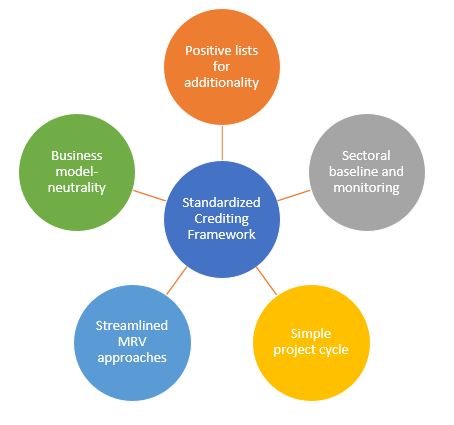
By shifting governance from a centralized international body to national institutions, the SCF reduces transaction costs, streamlines the project cycle through combined validation and verification, and introduces standardized baselines and country-specific default factors. By 2026, $50 million in carbon finance will be mobilized to provide 10 million people across Africa and Asia with clean and affordable energy.
- The SCF has catalyzed essential carbon market infrastructure and driven the adoption of legal mandates in Bangladesh and Madagascar for government bodies to authorize emission reductions for international transfer. It has also informed national carbon market strategies in Ethiopia, catalyzed development of carbon registries in Madagascar and Rwanda, and facilitated training for more than 340 policymakers and local experts. Operationally, the SCF has demonstrated that hands-on, transaction-based capacity building is highly effective when supported by dedicated in-country technical experts.
- The SCF proves that standardized baselines and streamlined monitoring protocols can reduce transaction costs without compromising environmental integrity. Its programmatic approach — aggregating thousands of micro-scale activities such as individual cookstoves or solar home systems into a single crediting program — overcomes the lengthy and cumbersome processes associated with earlier mechanisms like the Clean Development Mechanism.
- The SCF has further proven the viability of country-driven crediting mechanisms as a long-term solution. By equipping national institutions with governance structures and technical capacity to manage the carbon project cycle, the SCF has empowered countries to access climate finance independently. This sovereign capacity is essential for sustainable development and for helping host countries leverage carbon markets strategically to meet their nationally determined contributions.
- Looking ahead, the SCF can serve as a model for larger initiatives such as the World Bank Accelerating Sustainable and Clean Energy Access Transformation program, which seeks to mobilize $10 billion in external financing, including from carbon markets. By strengthening the regulatory environment, validating methodologies for energy access, and testing simplified carbon project cycles, the SCF has laid the groundwork for expanding carbon finance in Eastern and Southern Africa and South Asia.
Ci-Dev has published several lessons learned reports to capture and share knowledge from the roll out of the SCF in Bangladesh, Burkina Faso, Ethiopia, Madagascar and Rwanda. These reports draw on country-level implementation experiences to understand what worked, what didn’t, and what conditions shaped outcomes on the ground, including the portfolio-level “Results, Impact, and Lessons Learned” report.
- Rollout of the Standardized Crediting Framework: Results, Impact, and Lessons Learned
- Bangladesh - Lessons Learned from the Standardized Crediting Framework
- Burkina Faso - Lessons Learned from the Standardized Crediting Framework
- Ethiopia - Lessons Learned from the Standardized Crediting Framework
- Madagascar - Lessons Learned from the Standardized Crediting Framework
- Rwanda - Lessons Learned from the Standardized Crediting Framework